When we first started Train Adapt Evolve we did everything for free. It was a stellar business model. We started by giving out Omegawave mobile monitors to friends or athletes curious about the technology for free. I will admit, this was also for selfish reasons. I wanted to collect data, watch, and learn. This has now evolved into us putting athletes on our mobile platform and consulting with coaches and/or athletes.
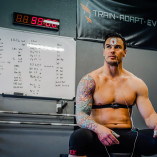
Recently we had an opportunity to consult with a UFC fighter and his coach preparing for an upcoming fight. The daily Omegawave results were not uncommon from what we have seen in the past which include former UFC champions.
Chaos.
As both Ben and I learn more from coaches or nutritionists in the MMA scene, one thing is becoming increasingly clear:
It is chaos.
The 1% of the 1%
I often hear S&C coaches talking about making their fighters tougher. This blows my mind!
If you are a MMA Fighter - you are tough.
If you fight for the UFC you are the 1% of the 1% of the toughest dudes on the planet. Congrats. I hope that is nothing knew to you.
So why in the hell do you think battle ropes and MB slams are going to make you tougher? Maybe I should ask the S&C coach that question. Why is making the athlete tougher the objective? If this was the case, we could go down to the local box gym, pick out a few guys who are burpee’n their faces off at the moment and throw them in the cage.
That toughness won’t last long.
An S&C coach with a “toughness” objective can do more harm than good. Messing with psychology via exhaustive work is sending up a Hail Mary and is a crap tool. Get rid of it and try to look into the future. Wholesale changes will not happen overnight and progress made in a short 8-12 weeks stint of training will be dependent on the athlete’s daily readiness during camp and structural adaptations prior.
In a sport where multiple qualities need training, our job may be better suited in managing fatigue (if no one else will) and secondly, filling in the performance gaps when we can.
We need to take a supportive role.
Therefore structuring depleting-type workouts in the morning, then sending the athlete off to their wrestling coach or sparing in the afternoon is a shit job.
Without a doubt there have been fighters not at the top of their game solely because of old school beliefs still held by S&C coaches.
Chalk one up for Toughness!
Lifestyle
“I am always training.”
Is common phrase often heard in MMA and I don’t doubt that the athletes are in fact training, but are they including the necessary lifestyle modifications to support the training - sleep and nutrition?
Both are always emphasised during training camp but if the athlete is “always training” those lifestyle habits need to be a mainstay day to day. Living hard and training hard don’t mix or have a long shelf life.
If the truth be told, we have have seen signs of overreaching even before training camp has begun - a combination of training and poor lifestyle choices. This could explain the inconsistencies, injuries, and question marks that surface about a fighter’s preparation. Entering training camp in this state will only be maintenance job at best.
The mentality of “living the athlete life” for 8 or 12 weeks at a time is not enough.
We believe post fight is just as important. Especially if a fighter has received a mild to severe brain injury. This opens up the body “literally” to both gut and blood-brain barrier permeability. Taking the necessary steps post fight can not only set the athlete up for the next training period but can also contribute to the athletes health which may prolong their career.
Communication
The biggest hurdle in the process is communication between the coaches. In most cases there is not one person managing the stress of the athlete. General the athlete is left on his own to navigate the process with a collection of coaches/voices. That lack of one true voice steering the ship will no doubt lead to insecurities and unorganized preparation.
There are current UFC fighters that have a team of coaches (S&C, boxing, wrestling, Muay thai, Jujitsu, etc) that have no idea what the other coach is doing, or how the athlete is recovering. All they know is how they are going to implement their own specific agenda. This usually ends with an overload of suboptimal training with very low emphasis on quality.
The bright spot is there are a camps structuring their team using an integrated approach. The two that come to mind are the Blackzilians and Team TakeDown. Medical, S&C, and the multi-discipline coaches are all on the same page, sharing notes, collaborating, and adjusting the fighters preparation.
If you are a fighter, start the conversation with your team. If you are a coach, start the conversation with the other coaches. If not there will no doubt be uncomfortable conversations later through defeat or injuries. Avoid the chaos.
I once was asked “Can you really build a Healthy CrossFit Athlete?”
I mention this not because it’s difficult question to answer, but how disheartening it was to hear — the question is an acknowledgement of a problem. Now this is not a shot at CrossFit, these days you can interchange the word CrossFit with any other name in sports. It’s all the same problem stemming from a lack of education and awareness from the coaches - Regardless of the sport.
I can see the frustration from the enlightened few coaches who are really trying to dig deep — searching for the truth. These coaches spend a lot of time and a butt load of money on their education — certs, seminars, and conferences — always looking for answers.
Maybe I have my nose in too many books but what certification is really talking about biological systems and the combination of morphological and physiological adaptation?
As far as I can tell it’s all the same — a little bit of….
and we can’t forget about this…
Some dress it up by showing off their genetic freaks while others try to build in a perfect assessment protocol. All trying to add value to the same information being sold.
This is why writing about fitness and health on the internet is redundant. The same stories being told by different voices — some witty, some matter of fact, some copy and paste.
“If you can’t say something interesting don’t say anything at all.” — These are words I am trying to live by.
As a mentor of mine once warned me “I don’t want you to sell your soul to the internet” and he is right for saying so, because there is always someone with a cooler website, steeper marketing budget, knows the right people, or just plain talks louder and more often.
I know this because Train Adapt Evolve has been accused of the same but I can honestly say — like the “enlightened few” — we are searching for the truth.
Simply, all the stuff I wish I was taught early on: biological systems and the combination of morphological and physiological adaptation.
No more telling the same stories.
I won’t guarantee you will be rolling in your seats but I can guarantee that the information I will discuss you will see in action. We will have a weekend of exploring the use of not only the Omegawave technology but also Moxy Muscle Oxygenation Monitors.
The impromptu tests that can be created having a Woodway Treadmill, Jacobs Ladder, Rowers, Airdynes and all the strength equipment at our disposal combined with the different perspectives from the therapy, nutrition, and strength and conditioning fields will make for a unique learning environment.
For instance, I sent the message below to a client who is highly athletic and been with us for about a month, in which we have made huge strides.
“My value add will likely diminish for you when I teach you all the lifts and get you moving really well consistently. There are always little tweaks that we can find, but you are self-motivated and smart sooo programming may be all that is needed after we accomplish what we set out to from the beginning.”
This may strike some as odd, why would I tell a client they may not need me for more in-person training?
We are expensive and that is unlikely to change any time soon.
It is the right thing to do.
This client sought me ought for a specific reason which we will have fully addressed in two months time. My job is not to sign this person up for lifetime training, it is to get them doing what they love to do better, more confidently, and most definitely without pain. Now if that thing they love to do is training with me – great. If it isn’t, carry on and come back when you need further insight.
This ideology of doing the right thing seems to be lost in this snowballing business of health and fitness. I get it, people have bills to pay and lights to keep on, but I have found if you do the right thing it tends to come back around, especially in a field that tries to up-sell every chance it gets.
Shit, we tell potential clients they can only buy a month of training because we don’t know if it is going to be a good fit. They have to prove that they can live up to what we ask them to do. Yet, for some of our clients I have zero hesitation signing them up for three months because they desperately need that face to face interaction/direction. We work well together and they value what we do. I always try to contemplate - is this the best choice for this particular client and am I the best professional to help them? If the answer is no, then I take a good hard look at what is the best course of action and who or what might be a better fit.
Davis and I do a lot of things that don’t make sense financially and go against the fitness grain. We can do this because we aren’t married to a giant facility. We eval athletes for free for other trainers. We have been known to monitor athletes for pennies. We nearly always agree to get on phone calls with other coaches or young people who may want to ask us about what we do or how we do it. We got into this industry to help people and collaborate and god damnit that is what we are going to do
….and here comes the sales pitch…kind of
We created this upcoming seminar – Optimizing Athleticism: The Health Performance Solution (August 8th and 9th) and it is going to be a horrendously good time. I can see it already. It will be a ton of effort, but it will blow people’s minds.
Transparency.
We will make zero dollars on this seminar. It will all go to putting it on. From a monetary standpoint we would be better off selling protein shakes on the street corner.
Maybe that is really stupid, but I desperately wanted to get Dr. Rakowski in front of our network of coaches and functional medicine practitioners here in Austin because I know his message and its delivery are so strong. Every functional medicine seminar I go to, I chat with people about what I do and inevitably someone always asks, “Oh have you heard of Dr. Rakowski?!!” He is that well known in the field and the practical tips and tricks regarding heavy health and performance concepts that you are going to take away from this two day seminar will be unlike anything out there.
So when you register, know that you are paying $295 to learn how to do the right thing by your clients, friends, and family. Know that we are putting this on so that we as a unit can help transition this industry from diet and exercise peddlers to citizen scientists, healers, and listeners who act with both integrity and knowledge, a ruthless combination.
Tony Gentilcore has some fantastic posts about PRI (Postural Restoration Institute), as well as coming out the other end of the PRI tunnel as a strength and conditioning coach. I would highly suggest reading them here, here, and especially f$cking here. I’ve been into breathing for about 4 years (there is a joke there, but I won’t take it).
Breathing mechanics peaked my interest when I saw that the best movers looked relatively at ease and tended to breathe through their belly under load. I then went to a workshop by Jim Laird and I knew I was missing a big piece of this breathing, inner ab, pelvis, shoulder girdle, conundrum, so I dug deep into PRI for over a year (I’m still digging and this is not a long time by any means, PRI has been around since the 70s, and breathing well forever), taking all the courses and regularly shadowing one of the best PRI PTs Steve Cuddy.
Also, we have had the opportunity to run about 200 evals on athletes utilizing a combination of PRI, Gary Gray, and FMS measurements. Some PRI heavy folks will scream, “why do you need anything else!” Well, we just like to be absolutely certain and tell the story to the client as best we can and also get them back on the ground to look at what happens up and down the chain. What we saw were tons of similar compensations across the board that correlated to the sport in question. We tweaked most of our warm-ups to include a lot of breathing “add-ons”.
We also consistently added in more lateral work. But the breaking point for us came when we started looking outside the PRI box, while still maintaining a PRI mindset into other methodologies that address breathing and physical capabilities. Believe it or not PRI did not invent breathing and you can see its foot print in nearly every martial arts practice, yoga, buddhism, and even Russian weight lifting and kettlebell methodologies.
PRI has done a fantastic job of highlighting the inherent asymmetries of the human body and has built a community as well as a vocabulary to express different positions and compensations (some hate this inclusive cultish aspect and I understand that view). But, as strength coaches we have to remember that PRI is based in the physical therapy world and at times it can be a little too fuffy to get the job done in the weight room and at other times we may need to just stop tinkering and accept and be an active bystander to genetic superiority.
To my knowledge the picture above is the peak of the PRI abdominal exercise progression. A 1 arm plank in the pushup position or a modified belly lift. Granted this will take folks a while to do well. This exercise together with the appropriate regressions are incredibly fruitful and you can make it much harder with a balloon, but this exercise alone is not going to allow you to discard your weight belt and just rely on exhalation and tension to lift heavy loads.
For that, you need well…strength and conditioning methodologies and the viewpoint that every exercise you do is an ab exercise. I believe PRI would support this view as long as the fundamentals were done and progressed properly. For more on these “other” methodologies every strength coach should buy HardStyle Abs by Pavel Tsatsouline, its a steal at $2.99 on Amazon. Yes, it has a horrible Men’s Healthy title, but after taking the PRI courses it makes their inner ab exercises look like pre-kinder finger painting.
Now don’t go nuts and start jack-hanmering all your clients with Hardstyle everything, many, if not all people need to rebuild breathing patterns and only require child’s play done incredibly well, but some of Pavel’s exercises may allow you to get breathing/ PRI voodoo buy-in with your higher level athletes because they wont be able to do something as simple and deadly as a hanging leg raise with a forced exhalation whole maintaining a posterior pelvic tilt.
The last point is one that has come up in multiple conversations with my fellow strength coach at the University of Denver, Pat Estes and that is that maybe it is not the best idea to be blanket tinkering with the positions of the best of the best athletes, those 1% of 1% adapters. Maybe the reason they are the best of the best is that they are really successful in that pattern.
AKA if you have to put someone in a PEC (overextended) pattern to sprint well, but the best of the best train and play in this over extended PEC pattern, what gives? Thus, instead of tinkering with their positions and becoming attached to getting all athletes to some imaginary neutrality that their sport may inherently pull them out of, maybe we can work to bulletproof them in the pattern predicated by their sport utilizing all our fancy asymmetrical PRI concepts, as well as other recovery methodologies to keep them uninjured. Some things just have side effects.
If you like to drive your car fast you are going to have to replace your tires and breaks, check the alignment, and not be retarded.
“This (PRI) stuff IS important, and it definitely has its place in the grand scheme of things – ESPECIALLY if someone is in pain.”
- Tony Gentilcore
This is just an idea and a conversation. I love the PRI methodologies and Drs Hruska, Thomsen, Anderson, and Cantrell have taught me a huge amount, but I don’t believe we have this whole aspect of the integration of PRI and Sport figured out yet, and if we look around the world there are tons of great movers who have no idea what the hell PRI stands for and that to me provides a lot of evidence that there are many ways to skin this cat and also that not individualizing your PRI strategies and having a larger view could cause more harm than good - like anything a little bit of knowledge can be dangerous, especially in the weight room.
“Beware of the myth of building a base … always ask yourself – A base of what?” - Dan Pfaff
Anytime I am planning a General Preparation Period (GPP) I always keep the above quote in mind.
A base of what? Endurance? Speed? Strength?
In my mind we need a base of Movement.
For this GPP we have 3 priorities.
Synergy in Movement (Power)
Support Work for SPP and CPP
Lifestyle
Synergy in Movement
Just as the title claims I want all movements to work together. I want to see similarities in foot dynamics within Sprint Drills, Olympic lifts, and Plyometrics.
Simply we should see commonalities in all three.
This synergy enhances the athlete’s ability to stay injury free. It makes no sense to coach one way on the track and another in the weight room — and the reasons are not centered around “Transfer” via the weight room.
It’s simpler that that.
It’s not how much they are loading the bar or how an athlete mimics sprinting movements via strength exercises, its’ how they are loading joints and soft tissue structures.
We want synergy so we don’t have to chase problems via therapy or recovery modalities.
Hamza has progressed well this last year as it pertains to hitting positions during drills and jumping activities. Now that we have a little more time we will break down power development exercises specifically Snatch, Clean, and Jerk Variations (lighter load - technique emphasis) with the focus being full foot power development.
Support Work
Another goal of GPP is to do work that supports the specific work carried out in (SPP & CPP).
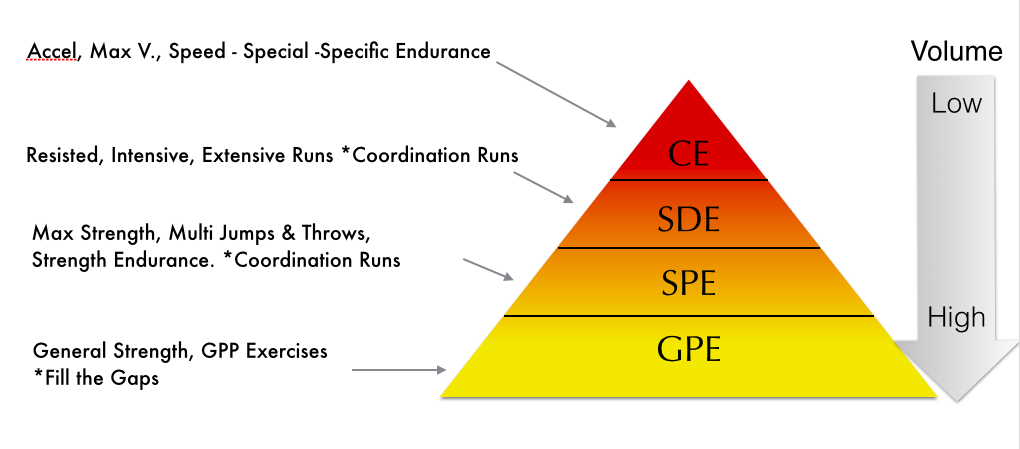
Probably a mashup of my endurance background and influences of Anatoliy Bondarchuk (Transfer of Training Vol.I & II, as well as The Olympian Manual for Strength & Size) but I Like the idea of never going too far away from the specifics and simple categorizing of training.
Bondarchuk’s classification goes as follows:
1. Competition exercises – essentially,
these exercises are the discipline in which the
athlete is competing. They are applied both in
competition and the training process. In the
training process they can be repeated under
competition conditions or they can be made
either easier or more difficult.
2. Exercises for Specific development
– exercises that replicate single parts of
the competition movement. Either the same
muscle groups or a major part of the groups
used in the competition movement are engaged
and the same systems and organs
used in competition are activated. With the
help of these exercises one can effectively and
selectively influence different physical abilities
and these exercises promote optimal training
condition. The level of ability and condition
attained via these exercises is realised in the
complete competition exercises.
3. Exercises for Special Preparation
– similar to the exercises for general development,
these do not replicate competition
movements either totally or partially, but the
muscle groups engaged can be the same as
those used in the competition movements.
These exercises activate the functions and
systems of the organism that influence performance
in the athlete’s main discipline.
4. Exercises for General Development
– exercises where competition movements
are not replicated either totally or partially and,
instead, other muscle groups are engaged.
These exercises do not lead directly to enhancement
of the competition result but promote
many-sided development, have a positive
effect on the levels of general working capacity
and coordination, and promote recovery.
No matter the sport this part of the planning will always take place. The outcome will look something like this. (Sport of Weightlifting can be found here)
This is obviously a poor knockoff of Coach Evely and Tyler’s work off of UCoach, but it’s simple enough for me when it comes to planning. All of the above categories are in play at all times during the whole year. The shape just morphs throughout the season in emphasis.
This is also mirrored in how we will monitor Hamza. Loose in GPP — making interventions in extreme cases (Ex: low DC potential on Accel/Coordination days will resort to plan B) and tight through SPP/CPP — looking for optimal windows for specific work.
Lifestyle
This is truly 1# on my list. Without this part everything above is just words on paper. This is also the part that Hamza has to own and be accountable for. Chaos in life will only lead to chaos on the track.
Like I mention in Feedback Analysis Hamza in the past was successful despite living an athlete’s lifestyle — now a bit older we need a different approach.
We have underwent the first round of blood work and are collaborating with Dr. Culleton (Central Texas Integrative Medicine). Culleton is unique for a Functional Med Doc both being an athlete himself and working with elite athletes in the past. His perspective has been instrumental in helping Hamza understand Quality of food is key and you can’t out supplement a crap lifestyle.
Priorities going forward: More Quality Fats, Quality Nutrients — Vegetables, and Improve Meal Frequency.
The basics, but sometimes an athlete needs to hear it from someone other than myself. This usually depends on the level of stubbornness an athlete possesses — Hamza has plenty.
The only hiccup we are facing is meal frequency through Ramadan. This will mean an early rise and will consist of good protein source and smoothie (spinach, fruit, protein powder, etc) every morning. We will move workouts to the evenings so Hamza can refuel right afterwards and the majority of the workouts through Transition (2 weeks) will be in the pool — a way to beat the Texas heat for an athlete we know is coming in dehydrated.
Sleep will be another quality we track. In the past he has averaged around 7.5hrs of sleep per night — with a caveat of 20+ moments of restlessness at times. This is now something we will be writing in on the training plans. The goal will be more sleep on nights after speed/strength sessions (8.5hrs). This is to balance out imposed stress with recovery — and being mindful of it. He has made the investment of a new mattress in effort to help with the moments of restfulness and we believe once nutrition is improved this quality will improve as well — data on this to come hopefully in future posts.
Now this lifestyle portion may seem a bit controlling from an outsider’s perspective, but I believe if you can’t adapt from the workloads — why do it? This last year we have taken a Short to Long approach in planning, even though he is a Long to Short athlete. Hamza wants to feel fit before he can feel fast and enjoys doing longer repeats/sets of special and specific endurance. Yet after the initial assessment when we first started working together (RMSSD of 40) I knew we had 2 options. Low volume of slow running or low volume of fast running. Lifestyle forced my hand to choose the latter. This year we will be planning on a Long to Short approach and I will post details of workouts and monitoring data throughout the year.
This idea to “Know Thyself” is nothing new. It can be traced back to aphorisms in Ancient Greece or sage teachings of “the Self ought to be the subject to know” in Ancient India.
The theme of “Self” can also be traced back through Christianity, Hinduism, and Buddhism.
The thirst to Know Thyself has also fueled physiologists, psychologists, sociologists, anthropologists, and philosophers alike. There is a teaching in Confucianism that you should reflect on yourself 3 times a day.
When is the last time you reflected on yourself 3 times a day? I mean truly slowed down and just. be. still.
Push notifications from social media, emails, phone calls, text messages, adult responsibilities — Who has the time?
Confucius says 3 times a day but Confucius never had ESPN.
We are inundated with dings, illuminations, and vibrations — information, information, information!
We have no time for silence or clear thought.
“True intelligence operates silently. Stillness is where creativity and solutions to problems are found.” - Eckhart Tolle
We then operate in chaos and to survive chaos we limit our decision making — in other words we form habits and often times not good ones.
This lack of mindfulness and reliance on habits only perpetuates our stress. Being mindful is always the brake, if you don’t use it sooner or later you run out of gas.
Coaches Get Ready
With more and more tech companies creating applications for health, sooner or later you will have athletes walking into your gym with quantified self knowledge. That means you better have answers.
A recent conversation with a coach/business owner asked “Why would I want my clients to monitor themselves? They would only come in 2 or 3 times a week? Why would we market the 4 or 5 time (unlimited) option? We would lose money.”
Like I said you will need answers. For us at TAE our answers are always “Less is More” and Health is always first.
Below is a video of Carl Valle who talks about the “Quantified Self” and I am in full agreement.
This is the future. As I stated above an individual’s need to “Know Thyself” is not going away anytime soon. Though Carl states this will be a disruption to the healthcare industry, I believe it will be a disruption to the fitness industry first. What do you think?




Recent Comments